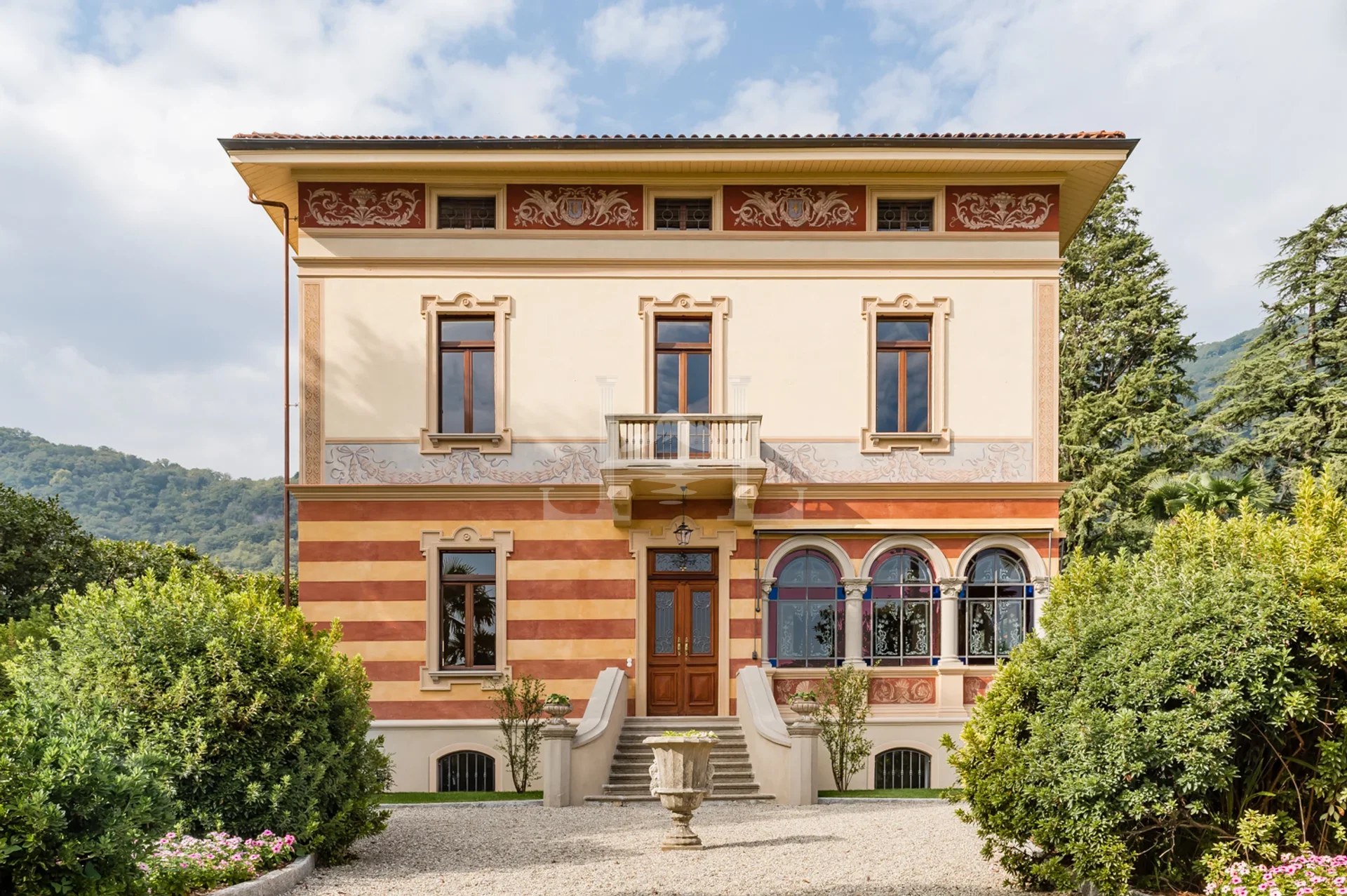
Period Villas on the Italian Lakes
Liberty, Eclectic and d'epoca villas on Lake Como and Lake Maggiore
The great villas of Lake Como and Lake Maggiore were carefully composed, not merely built. During the late nineteenth and early twentieth centuries, industrialists, aristocrats and prosperous professionals commissioned houses that expressed their wealth through the most exuberant architectural language of the period. What remains is an inheritance that cannot be recreated: sinuous ironwork, ornamental stucco, lake-facing loggias and private boat landings that have stood for more than a century on shores that have changed very little since.
Liberty style: Italy's Art Nouveau
Between roughly 1900 and 1915, the prevailing architectural language of the Italian lakes was the stile Liberty, Italy's interpretation of the Art Nouveau movement then spreading across Europe. The name derives from the London department store Liberty & Co., whose imported fabrics and decorative objects had brought sinuous, naturalistic ornament into Italian middle-class taste during the 1880s. By 1900, this aesthetic had extended from textiles into architecture.
Liberty villas on the lakes are readily identifiable: sinuous iron balustrades and gates decorated with floral or plant motifs, stucco facades modelled with foliage, swags and female figures, large windows designed around the lake view, and broad lake-facing loggias (logge) that soften the boundary between interior and garden. Facades are seldom symmetrical. The style favours asymmetric composition, with each element subordinated to the organic whole.
Milan and Turin produced celebrated Liberty apartment buildings, yet the lakes gave the style its grandest residential expression. Private lakefront plots, wealthy clients and a culture of conspicuous villeggiatura combined to produce Liberty villas on a scale rarely seen elsewhere in Italy.
Eclectic style: the historicist villas
Before Liberty, and continuing alongside it into the early twentieth century, the stile eclettico was the dominant language of Italian villa architecture. Eclecticism draws freely on historical styles, so Neo-Gothic, Neo-Renaissance, Moorish and Neo-Baroque elements may appear on the same facade, assembled with differing degrees of discipline. The results range from architecturally coherent to pleasurably outlandish.
Eclectic villas are particularly common on Lake Maggiore, especially around Stresa, Pallanza and Baveno, as well as along the western shore of Lake Como. The lakefront vocabulary includes crenellated towers, pointed Gothic windows, Moorish arches and terracotta ornamental panels. The Villa Taranto botanical gardens at Verbania and the Villa Carlotta at Tremezzo, both open to the public, show this tradition applied on the largest possible scale.
D'epoca: the market term
In Italian estate agency terminology, villa d'epoca, literally "period villa", is the general term for any property with recognised architectural or historical character. On the lakes, it generally refers to pre-1945 construction where period details remain: original ironwork, ornamental stucco, period tile work in bathrooms and kitchens, and the typical arrangement of the villa, with a formal entrance, piano nobile reception rooms, sleeping floors above and service areas below or separate.
D'epoca does not mean that a property has listed status, although many examples are protected. For a buyer, the term indicates a category defined by its irreproducibility. These buildings may be preserved or restored. They cannot be recreated.
Hallmarks of the authentic lake villa
It helps to know which details matter. The most architecturally intact lake villas tend to share several recurring features:
- — Lake-facing orientation: rounded or faceted volumes directed towards the water, with the principal reception rooms opening onto the full panorama.
- — Original ironwork: cast-iron railings, gates and window guards in Liberty floral patterns or Eclectic historicist designs. It is expensive to reproduce and cannot be replaced when intact.
- — Ornamental stucco: decorative cement panels on gable ends, friezes above windows and modelled cornices. Period stucco requires specialist restoration, which makes an intact example an asset.
- — Logge and terraces: covered lake-facing loggias are the defining spatial feature of the lake villa. They frame the water view and offer shade. Without them, the typology does not really work.
- — Period tilework: majolica or encaustic tile floors in entrance halls, bathrooms and kitchens, with Venetian terrazzo in reception rooms. Original tile is difficult and costly to match.
- — Imbarcadero: a private boat landing, with stone steps running directly into the lake, is the feature that distinguishes an authentic lake villa. Licensing rules make new imbarcaderi almost impossible to create, so existing ones are among the market's most valued features.
Soprintendenza constraints
Period villas with recognised architectural or historical value come under the Soprintendenza Archeologia, Belle Arti e Paesaggio, the Italian authority responsible for protecting cultural heritage and landscape. For a buyer, this has three practical implications.
First, prior Soprintendenza authorisation is required for any external modification, including facade treatment, window replacement, a gate or a terrace alteration. The process is neither quick nor certain, and proposals that depart from the original materials or character are routinely refused. Second, restoration must use matching original materials: limestone with limestone, hand-made brick with hand-made brick, lime render with lime render. Third, structural alterations that could damage historic fabric are closely controlled. Internal reconfiguration is usually possible, while external volumes and historic elements remain protected.
These restrictions protect value. A property under Soprintendenza oversight retains its architectural integrity over time, because interventions that would undermine it are simply not permitted. Heritage protection therefore serves as a form of quality assurance.
Restoration economics
Restoring a period lake villa to a luxury habitable standard typically costs between €2,000 and €5,000 per square metre in specialist labour and materials. This includes structural consolidation, roof and drainage work, facade and stucco work, period-specification windows, ironwork restoration, interior finishes and mechanical and electrical systems. For a villa of 600 sqm, this indicates a restoration budget of €1.2 million to €3 million, before furnishing and landscaping.
These figures should be considered alongside the purchase price whenever you assess a d'epoca opportunity. A villa offered at an attractive price may require restoration spending that changes the calculation entirely. A villa in demonstrably good structural condition with intact period finishes may prove the more economic acquisition even with a premium asking price, once the total cost is modelled.
Luxury Lakeview commissions an independent structural survey for every period villa before recommending it to a buyer. We do not present properties we would not present to a family member. Our role is to ensure that you understand exactly what you are buying and what will be required to bring it to its full potential.
Market position and scarcity
Genuine unrestored period villas on Lake Como and Lake Maggiore are becoming scarce. Over the last two decades, partial modernisation has steadily reduced their number: original windows have been replaced with aluminium, decorated stucco has been rendered over and imbarcaderi have been converted into terraces. Properties with fully intact period character and sound structural condition are becoming a smaller category.
Demand has developed in the opposite direction. There are more international buyers who understand architectural heritage and actively seek it than there were before, increasing the premium for a fully intact example. The best opportunities seldom appear on open listing platforms before a private introduction secures them.
Luxury Lakeview specialises in finding period villa mandates before they reach public listing. Long-standing relationships with families, trustees and estate administrators provide access to opportunities that are never advertised.
Contact our team for a confidential discussion of period villa opportunities on Lake Como, Lake Maggiore or Lake Orta.
Last updated: 2026-05-07